Last month we made a claim. Turn the spec into tests, and you catch the bugs that a diff-scoped review misses. This month we put that claim to the test on three real products. We gave TrueCourse nothing but their published documentation, ran what it generated against a live instance, and then verified every finding by hand, against the source and against the issue tracker. Here is what it found.
The setup
Three open-source products, picked because they are popular, well documented, and expose exactly the surfaces people are wiring AI agents into right now:
- Strapi, for its brand-new MCP server, admin-token auth, the REST content API and the Content Manager.
- Documenso, for the v2 signing API (envelope, recipients, fields, send, sign) and the web signing UI.
- Cal.diy, the community fork of Cal.com, for the v2 bookings and slots API and the public booking pages.
The pipeline is the one from the last post: spec scan reads the product's own docs, guard generate writes an executable scenario per testable claim, guard run executes them against the product. No human wrote a test case.
TrueCourse runs all of that on its own. It reads the docs, writes the scenarios, runs them, and hands you each failure with its evidence and the doc section it is bound to. For this article we went one step further and checked every finding by hand, the way a maintainer would check a bug report. We read each failure against the doc sentence it cites, traced it to the line of source that misbehaves, found out who changed that line and when, searched the project's tracker for it, open and closed, and checked whether anything merged since already fixes it. So every finding below comes with a file, a line, a date and a tracker answer.
Each finding is one of three things:
- Real defect. The product does not do what its docs (or its own schema) say, and a user following the docs is harmed.
- Doc bug. The product is sane and intentional, the doc text is wrong.
- Edition mismatch (Cal.diy only). The docs describe the commercial Cal.com, and the open-source fork does not ship that feature. Not a defect, but almost none of it is written down where a self-hoster would look.
A word on AI-written code before the numbers, since that was the subject of the last post. For some of these bugs we have evidence the change was written with an AI agent, in the form of the co-author line the agent leaves on the commit. For the others we found no such footprint. We treat all of them the same way. Most of these changes were made in the last year or two, by teams with access to the same AI coding and review tools everyone has, and those tools missed the bugs. Whether a model or a person typed the line matters less than the fact that nothing in the loop was checking the code against what the product promised.
The scoreboard
| Product | Defects | Doc bugs | Unreported | Fixed later |
|---|---|---|---|---|
| Strapi | 10 | 7 | 17 of 17 | 0 |
| Documenso | 9 | 7 | 9 of 16 | 1 |
| Cal.diy | 13 | 3 | 15 of 16 | 1 |
49 findings across the three. 41 of them are on no tracker anywhere. Six of the Documenso ones had been noticed independently by one community contributor, whose seven docs PRs (#3133 through #3139) have sat unmerged since late July. Two were fixed upstream after the build we tested, and both come up below. Cal.diy also produced thirty edition mismatches, counted separately and explained in its section.
Strapi: the bugs that shipped with its new MCP server
We found ten real defects in Strapi. Seven of them are in code that is only months old, the April to June 2026 work that added the MCP server and admin-token permissions. The other three are older and had simply never been noticed. None of the ten was on Strapi's tracker. Here are two of them, both on the MCP server, and one small one we did not expect.
Admin-token permissions are deleted at every restart
Strapi's Admin tokens page opens its Configuration section with a simple promise:
Admin tokens are configured entirely from the admin panel. No code-based configuration is specific to Admin tokens.
TrueCourse turned that sentence into a scenario and bound it to the section it came from. Abbreviated, this is the file it committed (the real one has the same seven steps, each with its full request body and a note explaining what it is for):
binds:
- doc: docs.strapi.io/cms/features/admin-tokens.md
  section: admin-tokens/configuration
steps:
- boot: { expect: { ready: true } }
- request: POST /admin/login                          # the seeded admin's session
- request: POST /admin/admin-tokens                   # mint a token of our own
    adminPermissions: [{ action: plugin::content-manager.explorer.read,
                         subject: api::article.article }]
  expect: { status: 201 }
- request: PUT /admin/admin-tokens/${tokenId}         # configure it the way the panel does
  expect: { json: { data.adminPermissions[0].action:
                    { equals: plugin::content-manager.explorer.read } } }
- request: POST /mcp  tools/list                      # control: the grant took effect
  expect: { body: { contains: '"name":"list_article"' } }
- boot: { expect: { ready: true } }                   # restart, change nothing else
- request: POST /mcp  tools/list                      # the same question again
  expect: { body: { contains: '"name":"list_article"' } }
Then it booted Strapi from source in a sandbox with a seeded database and walked the steps, recording every request and response. The transcript for the last four:
step 4  PUT  /admin/admin-tokens/10                     200
        adminPermissions: [explorer.read on api::article.article]
step 5  POST /mcp   tools/list                          200
        tools: list_article, get_article
step 6  boot the server                                 healthy
step 7  POST /mcp   tools/list                          200
        tools: []

mismatch (step 7)
  expected: body contains "name":"list_article"
  actual:   {"result":{"tools":[]},"jsonrpc":"2.0","id":2}
The token still authenticates. It can just no longer do anything. No error, no log line, and the panel simply shows the permission unchecked. An MCP agent or a CI token configured this way dies at the next deploy, crash or supervisor bounce.
The reason is a collision between old code and new. Strapi's boot runs a permission cleanup (packages/core/admin/server/src/services/permission/queries.ts:90-187) that deletes any permission row whose properties are all nil. That rule is from 2021 and is correct for role permissions, which the panel always writes with a fields property. Admin tokens, added by PR #25657 in April, store properties: {} on purpose (nil means "all fields" at request time). On a localized content type both fields and locales are nil, so the reaper eats the row. Not fixed on develop as of mid-August, and not on Strapi's tracker.
A database error hands the client the raw SQL
The second one we did not go looking for. Strapi's MCP server page lists about twenty filter operators the list tool accepts ($eq, $contains, $null and so on), so TrueCourse wrote a scenario that tries each one. To have something to filter, that scenario first creates three articles through the MCP create_article tool:
binds:
- doc: docs.strapi.io/cms/features/strapi-mcp-server.md
  section: mcp-server/usage/content-management-through-prompts/filtering
steps:
- request: POST /admin/login                          # the seeded admin's session
- request: POST /admin/admin-tokens                   # mint a token of our own
- request: PUT  /admin/admin-tokens/${tokenId}         # give it read + create on articles
- request: POST /mcp  tools/call create_article       # authorName: "TCRef-Writer"
- request: POST /mcp  tools/call create_article       # authorName: "tcref-writer"
- request: POST /mcp  tools/call create_article       # no authorName, for $null / $notNull
- request: POST /mcp  tools/call list_article         # then one step per operator ...
In one run, the third of those creates hit a database hiccup. That happens. What matters is what the MCP server sent back to the client:
step 6  POST /mcp  tools/call create_article             200
        {"result":{"content":[{"type":"text","text":
          "Tool \"create_article\" execution failed:
           insert into `articles` (`created_at`, `created_by_id`, `document_id`,
             `locale`, `published_at`, `title`, `updated_at`, `updated_by_id`)
           values ('2026-08-14 15:09:10.320', 2, 'nez829w0fwk50nas8b6n5df9', 'en',
             NULL, 'tcref-op-gamma-3d73b4faba', '2026-08-14 15:09:10.320', 2)
           returning `id` - database is locked"}],
         "isError":true}}
The full statement. Table and column names, the internal user id, every bound value, handed to whoever holds the token, and a read-only token is enough. On a unique-constraint violation the values can be other people's data. The same database error, hit through Strapi's ordinary REST API, comes back as a plain 500 with no detail. Only the MCP path leaks.
This is not a documented behavior anyone broke. It is code doing the opposite of what it says it does. Every MCP tool runs inside a wrapper whose own comment says errors are logged in full on the server and returned to the client as a "safe error response (no stack trace leak)". The logging half is true. The reply half is not. tool-registry.ts:104-113 formats the reply as `Tool "${name}" execution failed: ${error.message}`, and the database driver's message is the whole SQL statement. Introduced with the MCP server itself (PR #26371, May 2026). One line to fix. Not on Strapi's tracker.
And the small stuff
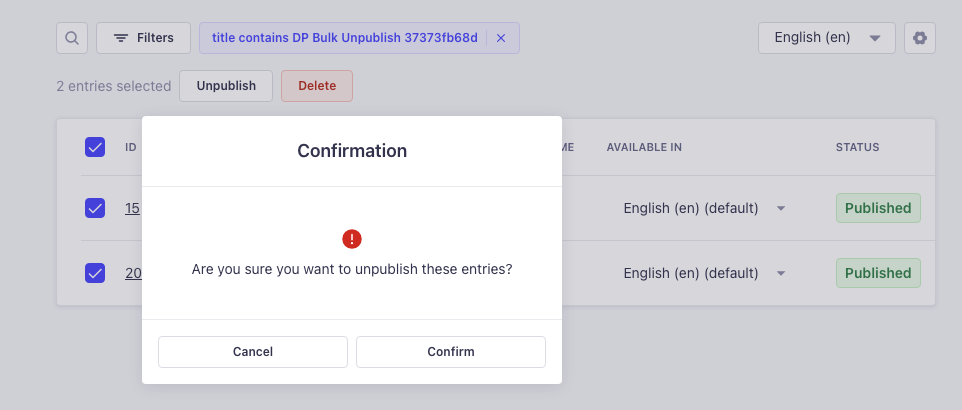
Not everything it finds is that serious, and that is fine too. The same run noticed that the bulk-unpublish confirmation dialog in the Content Manager says "Confirm" where the docs tell the user to click "Unpublish" a second time. Trivial to fix, and exactly the kind of small inconsistency that makes someone following the docs hesitate. Nowadays it is important to catch this type of bug too, to avoid the inconsistencies AI can introduce.
Strapi, in short
Seventeen findings, and we told you three. A behavior bug, a documented feature that silently stops working. A security bug, an error path that leaks what it should hide. And a small UI inconsistency that sends a user following the docs looking for a button that is not there. Most of the rest are the MCP server again, relation writes that silently drop or misreport what they did, plus a handful of pages where the docs describe a product that no longer exists.
None of them shows up in a crash, a log line, or a failing test suite. All of them showed up the moment the docs were read as a checklist.
Documenso: fixed after the release, when TrueCourse would have caught it before
In Documenso we found nine real defects and seven doc bugs, all in the v2 signing API and the web signing UI, the surface any integration drives to get a document signed. Nine of the sixteen are on no tracker. Six are the community PRs from the scoreboard, still unmerged. And one had already been fixed upstream by the time we looked, in a way that says more about how software actually ships than any of the others. That is the one to start with.
A limit of 100 in the release, 1000 in the docs
Documenso's Rate limits page states the budget in one line, and Your first API call and the workflow examples repeat it:
Limit: 1000 requests per minute per IP address. Response: 429 Too Many Requests.
The scenario is two steps: the first proves the headers exist at all, the second checks the number the docs give:
binds:
- doc: docs.documenso.com/docs/developers/api/rate-limits.md
  section: rate-limits
steps:
- request: GET /api/v2/envelope
  expect: { status: 200,
            headers: { x-ratelimit-limit:     { matches: "^[0-9]+$" },
                       x-ratelimit-remaining: { matches: "^[0-9]+$" },
                       x-ratelimit-reset:     { matches: "^[0-9]+$" } } }
- request: GET /api/v2/envelope
  expect: { headers: { x-ratelimit-limit: { equals: "1000" } } }
Step 1 passed, the headers are there. Step 2 did not.
step 2  GET /api/v2/envelope                            200
        x-ratelimit-limit: 100

mismatch (step 2)
  expected: header x-ratelimit-limit equals "1000"
  actual:   header x-ratelimit-limit was "100"
The build hardcodes max: 100 in packages/lib/server-only/rate-limit/rate-limits.ts. Documenso has since fixed it. PR #3081 raised the code and the docs to 1000 together, and the hosted product already runs it. But that fix is not in any release. Every tagged version, including the newest, still enforces 100, and the docs a self-hoster reads while installing it say 1000.
We like this one because it is what spec drift looks like when nothing is checking for it. The docs moved. The release did not. Nobody wrote a test for the number, because who would. The guard read the number off the page and checked it, and the mismatch it found is exactly the one a self-hoster hits when they size a client to the docs and get throttled at ten percent of the budget.
A sent document is supposed to be frozen. It is not.
This is the rule every e-signature product lives by, and Documenso states it three times, on the Document lifecycle page, in the Documents API reference, and in the user guide for adding recipients:
You cannot modify the document content, recipients, or fields while it is pending.
The scenario builds a document from a template, adds a signer and a signature field, sends it, confirms it is now PENDING, and then tries every change the docs forbid, expecting each one to be refused:
binds:
- doc: docs.documenso.com/docs/concepts/document-lifecycle.md
- doc: docs.documenso.com/docs/developers/api/documents.md
- doc: docs.documenso.com/docs/users/documents/add-recipients.md
steps:
- request: POST /api/v2/envelope/use                  # create a document from the seeded template
- request: POST /api/v2/envelope/update               # sequential signing order
- request: POST /api/v2/envelope/recipient/create-many  # one signer
- request: POST /api/v2/envelope/field/create-many      # one signature field
- request: POST /api/v2/envelope/distribute             # send it
- request: GET  /api/v2/envelope/${envId}
  expect: { json: { status: { equals: "PENDING" } } }  # control: it is sent
- request: POST /api/v2/envelope/recipient/create-many  # add a second signer, after sending
  expect: { status: 400 }
- request: POST /api/v2/envelope/recipient/update-many  # change the first signer's email
  expect: { status: 400 }
  ...                                                   # delete a recipient, add a field, ...
Steps 1 to 6 passed. The document exists, it has been sent, it is PENDING. Step 7 was the first forbidden change.
step 7  POST /api/v2/envelope/recipient/create-many          200
        {"data":[{"envelopeId":"envelope_urehkhlnlvltdbhv","role":"SIGNER",
                  "email":"tcref-late-6f2f321c45@documenso.test",
                  "signingStatus":"NOT_SIGNED","token":"9Pfx8Fnn0S32rwYhyOfL5", ...}]}

mismatch (step 7)
  expected: status 400
  actual:   status 200
A new signer, persisted, with a live signing token, on a document the existing signers agreed to under a fixed party list. The API said yes and returned the row. Nothing about the document's status stopped it, and nothing told anyone.
The reason sits in packages/lib/server-only/recipient/create-envelope-recipients.ts:62-74. The service has two gates. One rejects the change if the document is already completed. The other looks like a status check but only applies to envelopes with advanced (AES/QES) signatures and returns immediately for a normal one. Nothing on the path asks whether the document is still a draft. The same two-gate shape is in recipient update and delete and in field create and update, so the scenario's next steps, changing the first signer's email, deleting a recipient, adding a field to the sent document, would all have gone through the same way. Introduced with the recipient endpoints in January 2025 (PR #1572). Not on Documenso's tracker, not fixed on main.
One more detail about that PR. It was reviewed, by CodeRabbit, which left thirteen comments and was the only reviewer on it. None of the comments is about the missing check, and there is no reason one should be. An AI code reviewer reads the diff and asks whether the code is well written. It has no way to know that three pages of the product's own docs promise a sent document cannot change, because that promise is not in the diff. That is the difference between reviewing code and verifying it. To catch this kind of bug you have to start from the spec, and turn what it promises into something that runs.
Documenso, in short
Sixteen findings, and we told you two. A limit the docs put at ten times what the shipped release enforces, fixed upstream but not released. And a core rule of the product, stated three times in the docs, that the API does not enforce, which passed an AI code review because the rule was never in the diff. The rest are the same shape, writes that answer 200 and quietly do the wrong thing, and seven doc pages that describe request and response shapes the API never had.
Cal.diy: what happens when the docs are for a different edition
Cal.diy is what Cal.com's open-source code became this spring. Cal.com split its product in two. The commercial version, the one running at cal.com, moved to a private repository. What stayed public was renamed Cal.diy, the community edition, "with all enterprise/commercial code removed", and the old public repository now just points at it. The docs at cal.com, though, still describe the commercial product. We knew that going in, and it turned the Cal.diy run into a different kind of test. Could we tell "the fork does not ship this" apart from "this is broken"?
It could, and the split is instructive. Thirty documented behaviors turned out to be Cal.com-only. Most of them come down to one thing. The public API reference describes a newer version of the bookings API than Cal.diy ships, so a self-hoster following it gets confusing errors, a drift that has been open on Cal.diy's tracker as #28762 since April. The rest are features the fork removed. None of that is a bug. All of it is a page a self-hoster reads and cannot follow.
Underneath the edition gap we found 13 real defects and 3 doc bugs in Cal.diy, 15 of them on no tracker. Here are two of them, one from the booking page and one from the API.
The out-of-office day that stays fully bookable
Cal.com's help centre explains Out of office in plain terms:
Out of office (OOO) lets you mark periods where you're unavailable so people can't book you. Each reason has an emoji that shows on your booking page during the OOO period. The entry appears in your list and immediately blocks new bookings for that date range.
The seeded host has an out-of-office entry covering 12 June 2030. The scenario opens the public booking page for that month and looks for what the docs describe, the day marked with the reason's emoji, disabled, with no slots on offer.
binds:
- doc: cal.com-help/help/availabilities/out-of-office.md
  section: out-of-office/add-an-out-of-office-entry
steps:
- navigate: /reference-host/ooo-consult?month=2030-06
  expect: { state: { role: button, name: "🏝️", disabled: true } }
- expect: { visible: { role: button, name: "🏝️" } }
- expect: { text: { matches: "^(?!...Back on the fifteenth...)" } }   # the OOO note stays private
Step 1 found no such button. Day 12 rendered as an ordinary, selectable day, and this is the screenshot it took:
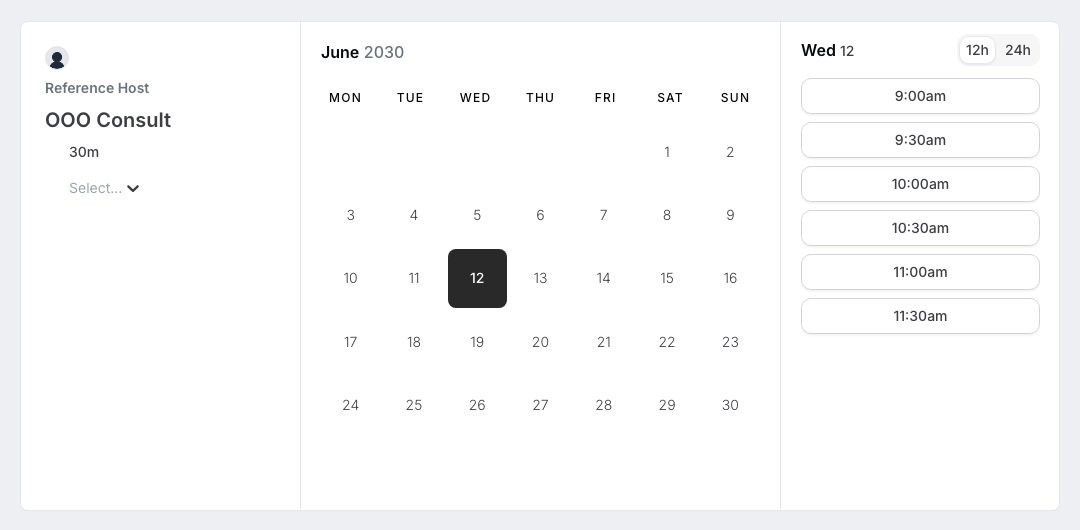
The out-of-office calculation (packages/features/availability/lib/getUserAvailability.ts:744-755) skips any OOO day whose weekday is not in the union of the host's weekly availability rows. Date-override rows carry no weekdays. So a host whose bookable days come from date overrides, which is exactly what this corpus seeds, gets an empty out-of-office map, and the day is open. The same guard was copied into the Holidays feature, so public holidays inherit the hole. The code is older than the fork and the fork did not touch it, so this one is not Cal.diy's doing. Unreported.
The endpoint that says "success" and does nothing
The API reference for reassigning a booking to a specific host is one sentence long:
Currently only supports reassigning host for round robin bookings.
So the scenario books a plain, non-round-robin event type and asks to reassign it, both ways the reference offers, expecting to be refused:
binds:
- doc: cal.com-docs/docs/api-reference/v2/bookings/reassign-a-booking-to-a-specific-host.md
- doc: cal.com-docs/docs/api-reference/v2/bookings/reassign-a-booking-to-auto-selected-host.md
steps:
- request: POST /v2/bookings                            # a plain booking on the seeded host
  capture: { plainUid: data.uid }
  expect: { status: 201 }
- request: POST /v2/bookings/${plainUid}/reassign/{{fixture:host.id}}
  expect: { json: { status: { equals: "error" } } }
- request: POST /v2/bookings/${plainUid}/reassign
  expect: { json: { status: { equals: "error" } } }
Step 2 answered:
step 2  POST /v2/bookings/{uid}/reassign/1                  200
        {"status":"success",
         "data":{"bookingUid":"...",
                 "reassignedTo":{"id":1,"name":"Reference Host", ...}}}

mismatch (step 2)
  expected: json status equals "error"
  actual:   json status was "success"
Two hundred, success, and a reassignedTo naming the host the booking already had. Nothing happened. When the fork removed the enterprise round-robin engine it kept API v2's dependency on it and satisfied it with stubs (packages/platform/libraries/index.ts:125-150):
export async function roundRobinReassignment(_args: { ... }): Promise<void> {
  // No-op in community edition
}
The tell is that the four sibling stubs in the same block throw "not available in community edition". Only the two reassign stubs return a silent success, and the route, the service and the success-shaped response around them are unchanged. Any integration that trusts the envelope believes a host handoff happened. This one is Cal.diy's alone, and it is not on its tracker. The commit that left the stubs behind, the fork commit itself, carries a Devin AI co-author line.
Cal.diy, in short
Sixteen findings once the edition gap is set aside, and we told you two. A documented feature, out of office, that a booker can walk straight through. And an endpoint that reports success and does nothing, which is the fork's own. The rest are the same kind of thing, a pending booking that gets auto-confirmed on reschedule, a slot hold anyone can extend, a reservation the next read does not see. One of them, a documented prefill that never reaches the phone field, was fixed on main five days after the commit we tested (PR #29740), in no release yet.
Why this is not another AI code review
Everything above was found on code that had already been reviewed, merged and released, and in at least one case reviewed by an AI code review tool as well. The bugs went through anyway, because none of them is visible in a diff. A missing status check looks like clean code. A hardcoded 100 looks like a constant. You only see the bug if you know what the product promised, and the promise lives in the docs, not in the pull request.
That is the difference. An AI code reviewer starts from the change and asks whether it is well made. TrueCourse starts from the specification and asks whether the product still does what it says, with scenarios that run against the real product like any other test suite. We ran it after the fact, on released code. On every pull request, the Documenso freeze check fails the day PR #1572 is opened, and the Strapi permission wipe fails in April, months before anyone noticed.
That pull-request gate is what we are building, and it is not open to everyone yet. We are putting it on a small number of teams' repos first, with their own docs as the spec. If you want your product held to what your documentation promises, on every change, ask for access and tell us which repo.
Methodology notes. Runs on 2026-08-13 and 2026-08-14 against Strapi 5.52.0 (develop @ c43e9ee1e2), Documenso 2.16.0 (3cf2963) and Cal.diy (calcom/cal.diy main @ 038381aeca), each run from source in a sandbox with a seeded database. Every finding was verified against its evidence bundle, the bound doc page, and the tested source. Verdicts come from evidence plus source reading, not from a live re-run. "Fixed after" was checked against each upstream default branch as fetched on 2026-08-15 and against tags. Tracker searches were bounded to three per finding. "Distinct" findings count one defect once even when several scenarios hit it. Cal.diy's commercial upstream is not public, so "fixed in Cal.com" could not be verified from source.